Article by:
DubaiDirectory

Dubbed the hottest hotel on Palm Jumeirah, FIVE Palm Jumeirah is a dare-to-be-d...

The first thing to establish is not who is nearest, but who is actually responsible for fixing your unit. In most Dubai tenancy contracts, AC maintenance falls on the landlord unless the contract explicitly states otherwise, and Ejari-registered agreements often spell this out in a clause worth re-reading before you spend a dirham. If your AC has stopped cooling in a villa in Al Barsha or Jumeirah, call your landlord or property manager first — you may be entitled to a free repair, and paying for it yourself can mean an argument at renewal time. If you're in a building on a district cooling network, the unit inside your apartment may not even be something a private technician is allowed to touch.
Search proximity matters less than you'd think in Dubai because most AC companies operate from a handful of industrial clusters — Al Quoz, Ras Al Khor, and parts of Deira — and dispatch technicians across the city by van. A company based in Al Quoz can reach Dubai Marina in 30–40 minutes outside peak traffic, similar to one advertising itself as "local" to JLT. What genuinely changes response time is the season and the building type. Between May and September, when outdoor temperatures sit above 40°C and every split unit in the city is running flat out, same-day callouts in Business Bay, Downtown, and Marina towers can stretch to 24–48 hours because demand spikes across the board. Book a maintenance visit in November or December instead, when technicians have slack in their schedule and you can often get a same-day slot and a lower rate.
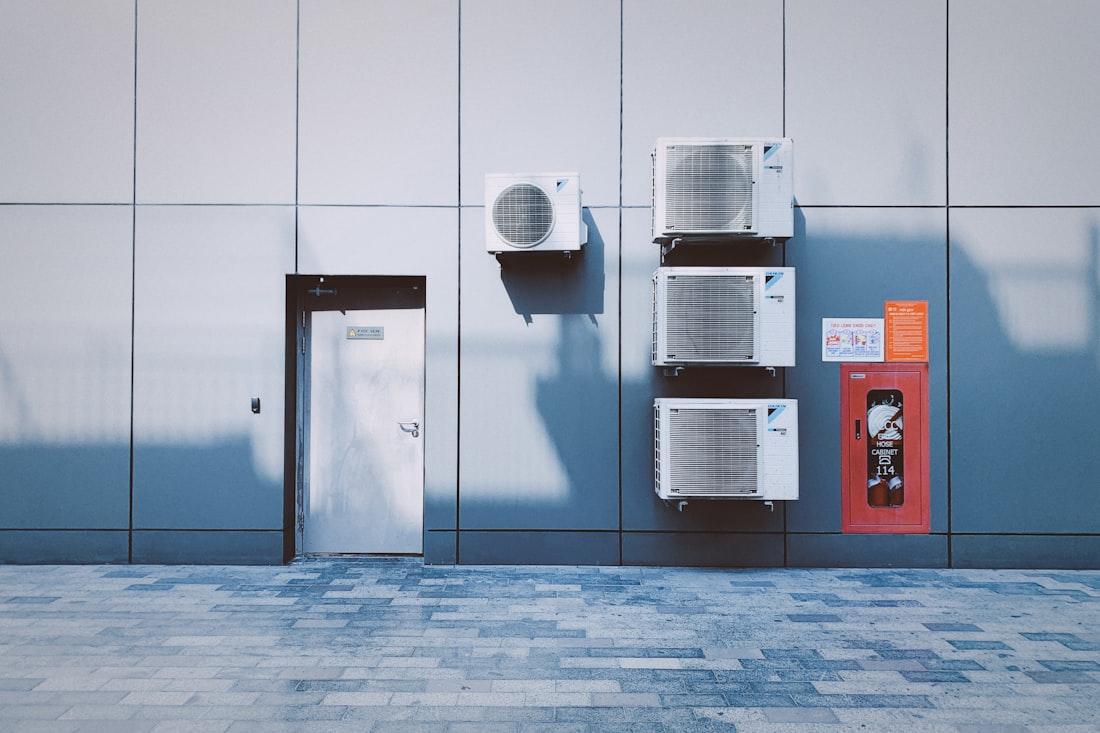
Standalone villas and townhouses in areas like Al Barsha, Umm Suqeim, and The Springs typically run on split or package DX units owned outright by the landlord, with the tenant free to call any DED-licensed contractor directly for repairs, though the cost should usually be recovered from the landlord under RERA's standard tenancy terms. Older apartment buildings in Karama, Deira, and parts of Bur Dubai use similar standalone splits, so the process is straightforward: call a company, get a quote, get it fixed.
Towers in Business Bay, Downtown Dubai, DIFC, and much of JLT are a different animal. These run on district cooling — chilled water piped in from a central plant operated by a provider such as Empower or Emicool — and the fan coil unit in your ceiling is only the delivery point, not the whole system. If the unit itself is faulty (a stuck fan, a leaking coil, a dead motor), a private AC company can usually attend, but any work involving the chilled water valves or building risers requires the building's facilities management team, and sometimes the district cooling provider directly. Calling a random technician off Google for a district cooling issue often ends with them telling you, correctly, that they can't touch it.
A legitimate AC company quotes in layers, not as one number. Expect a callout or inspection fee of AED 100–150, which most companies waive if you proceed with the repair. A standard split-unit gas top-up runs AED 250–450 depending on the refrigerant type and unit size — R410A units cost more to recharge than the older R22 systems, which are being phased out and increasingly expensive to source gas for. A full clean and service of a single split unit, including filter wash, coil clean, and drain flush, typically sits at AED 150–250 per unit, with a discount if you're servicing three or more units in one visit. Capacitor or fan motor replacement adds AED 150–350 in parts on top of labour. A full compressor replacement, the most expensive common repair, ranges from AED 1,500 to AED 3,500 depending on tonnage and brand, and any quote for this job should specify the compressor brand and warranty period in writing.
A proper written quote itemises parts and labour separately, states the refrigerant type being used, and gives a warranty on the work — 30 to 90 days is standard for a repair, longer for a compressor swap. If a technician gives you one lump figure verbally and wants cash before starting, that's your first red flag.
Ask which refrigerant your unit takes before they arrive, and see if their answer matches what's stamped on the unit's nameplate. Ask whether they'll use a vacuum pump and gauges before recharging gas — a leak that isn't found and sealed first means you'll be paying for another top-up within weeks, which is one of the most common complaints against fly-by-night operators. Ask for the company's DED trade licence number; in the UAE, air conditioning repair is almost always carried out through a registered company rather than an individual sole trader, and the technician should be able to produce a company ID. If someone shows up in an unmarked car with no uniform and no paperwork, you have no real recourse if the job goes wrong or the unit is damaged further.
The most frequent failure in Dubai's climate is a blocked condensate drain, especially from July to September when humidity is high and units run continuously — left unchecked, this causes water to back up and leak through ceilings, sometimes into the unit below in a shared building, which becomes a liability dispute between neighbours and management. The second most common issue is a refrigerant leak patched with a top-up rather than a proper leak-detection and repair; this is cheaper upfront but means you'll be back to square one, and out another AED 300, within a season. Compressor failures cluster in units over seven or eight years old that have never had a proper annual service, which is the strongest argument for a maintenance contract rather than reactive repairs.
If a repair fails within the warranty period and the company won't return, you have recourse through the Dubai Department of Economy and Tourism's consumer complaints channel, and for larger sums, the Dubai courts' small claims tribunal handles disputes up to AED 50,000 relatively quickly and without a lawyer. Keep every invoice and WhatsApp exchange — it's the evidence that makes a complaint stick.
For villa owners and tenants with multiple split units, an annual maintenance contract (AMC) covering two visits a year plus discounted emergency callouts typically costs AED 400–800 per unit annually, and it's usually cheaper than paying for two standalone services plus one emergency repair, which is close to the average failure pattern for a poorly maintained unit. For a single apartment with one or two units, it's often not worth the paperwork — book a service each November instead and keep the invoice as a record if a dispute over responsibility ever comes up with your landlord.
Dubbed the hottest hotel on Palm Jumeirah, FIVE Palm Jumeirah is a dare-to-be-d...
Conveniently located in the heart of Business Bay with easy access to both Inte...

 Log in with Google