Article by:
DubaiDirectory

Centrally located in a dynamic area, the hotel is a marquee location for discer...

Prices swing hard depending on whether you're paying a one-man WhatsApp contact or a licensed joinery company, and whether the job is supply-and-fit or fit-only using materials you've already bought. As a rough anchor: flat-pack furniture assembly runs AED 100-250 per item, a standard interior door supplied and hung is AED 400-900, and a single fitted wardrobe (2-3m wide, MDF with laminate finish) lands between AED 1,800 and 4,500 depending on internal fittings and hardware brand. A full fitted kitchen — cabinets, worktop excluded — typically costs AED 8,000-20,000 in an apartment and considerably more in a villa with a larger footprint. Bespoke furniture, TV units and pelmets are priced by the linear metre, usually AED 350-700 per metre for mid-range MDF work, rising sharply if you specify veneer or solid timber.
The cheapest quotes usually come from small workshops in Al Quoz Industrial Area, where a lot of Dubai's joinery actually gets made regardless of which company's van turns up at your door. Going direct to one of these workshops can save 20-30% on a company-branded quote for the same cabinet, but you lose the convenience of a single point of contact for delivery, installation and any comeback if something's wrong.
Dubai doesn't really have a tradition of sole-trader carpenters working legally on their own account. Most carpentry work is done through a company holding a DED trade licence (commonly listed under carpentry works or furniture and wood works), or through a freelance permit issued by a free zone such as Dubai Studio City or Nad Al Sheba Media Zone. A huge amount of the market also runs informally — a man with a van and a phone number passed around a residents' WhatsApp group — and while some of these individuals are genuinely skilled, you have zero recourse if the wardrobe door falls off in month four. If you're spending anything over a few hundred dirhams, ask for the trade licence number and check it means something: a legitimate operator will produce it without hesitation, usually as a PDF over WhatsApp within a minute.

If you rent an apartment in a building with facilities management — much of Dubai Marina, JLT, Business Bay and Downtown falls into this category — any work involving drilling, wall fixing or noise generally needs a maintenance NOC from the building office before the carpenter arrives. Most buildings restrict this kind of work to weekday hours, commonly 9am to 6pm, with Fridays and public holidays off-limits. Security desks will turn a carpenter away without a valid access pass, so book this a few days ahead rather than assuming same-day access. Villa communities such as Arabian Ranches, The Springs or Al Barsha are more relaxed, though gated communities still often require the contractor's company to be pre-registered with the community management for entry.
If you're a tenant rather than an owner, check your tenancy contract before anyone drills into a wall for a fitted wardrobe or shelving unit. Landlords in Dubai can and do deduct from the security deposit for unauthorised structural changes, and Ejari registration doesn't cover permission for alterations — that's a separate conversation with the landlord or the owners' association.
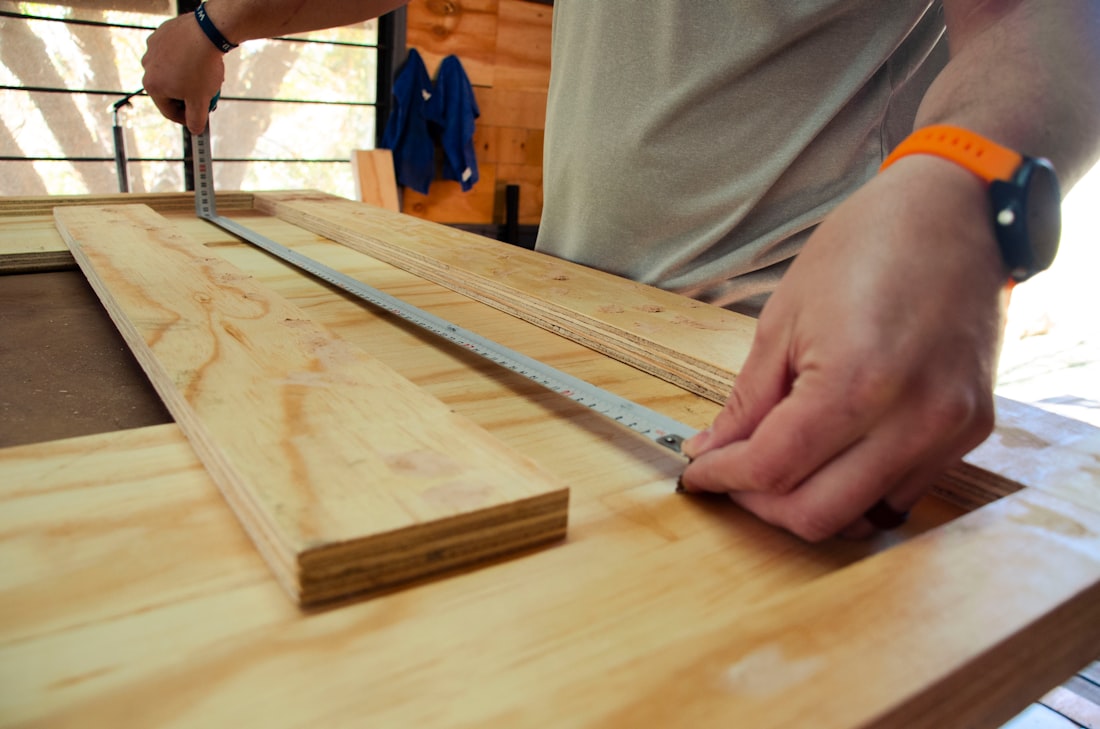
Ask what board he's actually quoting: E1-grade moisture-resistant MDF is the sensible minimum for Dubai given the humidity swings between AC-cooled interiors and outdoor heat, and it costs more than the E2 grade some fitters substitute without saying so. Ask which hinges and runners are included — generic hardware fails within a year of heavy use, while Blum or Hettich soft-close mechanisms cost more upfront but hold up. Ask whether the quote includes delivery and installation or just the fabricated pieces, since a surprising number of low quotes exclude both. And ask about warranty: a proper joinery company will offer six to twelve months on fittings and workmanship; anyone who won't commit to anything in writing is telling you something about how the job will go if it fails.

A written quote worth trusting itemises material type and grade, hardware brand, dimensions, labour and delivery separately, states VAT at 5% explicitly rather than folding it into a round number, and gives a completion timeframe. It should follow a site visit, not a photo sent over WhatsApp — measurements for fitted work in Dubai apartments are rarely as simple as they look, especially around AC ducting, skirting and uneven wall corners in older buildings in areas like Karama or Deira. A quote produced without anyone setting foot in your home is a guess, and guesses on fitted furniture end in gaps you'll be looking at for years.
Wood behaves differently in Dubai than it does anywhere temperate. Villas with poor insulation, apartments near the coast in Jumeirah or Dubai Marina, and any space where the AC cycles on and off rather than running constantly, all put real stress on timber and MDF joints. Cheap or wrongly graded board warps, swells at the edges or delaminates within a year, which is exactly why the grade of MDF matters more than most homeowners realise when comparing quotes. If a carpenter can't tell you the moisture rating of the board he's using, or seems unfamiliar with the question, that's a more reliable red flag than a low price.
Demand spikes hard in September and October, when residents who left for the summer come back and move into new flats, and again in the weeks before Eid when everyone wants finished interiors for guests. Booking a carpenter in peak season without at least a week's notice usually means a rushed job or a price premium of 10-20%. Summer months, particularly July and August, are the quiet stretch — workshops in Al Quoz have more capacity, quotes are more negotiable, and you'll get a carpenter's full attention rather than one squeezed between five other jobs.
Centrally located in a dynamic area, the hotel is a marquee location for discer...
Set in the heart of the prestigious Emirates Hills, our 18-hole championship go...



 Log in with Google