Article by:
DubaiDirectory

Enjoy 5-star luxury at a most convenient hotel address. Facing Dubai Internatio...

"Metal fabrication" covers three separate things and most disputes happen because the buyer and the workshop never agreed which one they meant. There's supply-only, where you take delivery of a gate, staircase or balustrade and arrange your own installation. There's supply-and-install, the most common arrangement for residential and small commercial work. And there's design-and-build, where the fabricator also produces shop drawings and, for anything structural, submits them to a consultant for approval before cutting a single sheet of steel. If your quote doesn't say which of these you're paying for, ask before you agree a price — installation, site access, and any making-good of plaster or tiling around the fixing points can add 15-25% on top of the fabricated item itself.
Dubai's fabrication trade is concentrated in a handful of industrial pockets, and the address tells you something about the workshop's overheads and scale. Al Quoz Industrial Areas 1 to 4 hold the largest cluster — hundreds of small and mid-sized workshops doing gates, staircases, balustrades, shopfronts and ornamental ironwork, often serving villa owners in Jumeirah, Umm Suqeim and Al Barsha nearby. Ras Al Khor and Al Aweer host heavier operations working in structural steel, tanks and industrial platework, generally cheaper per kilogram than Al Quoz because rents are lower and jobs are bigger. Dubai Investment Park (DIP) and Jebel Ali attract manufacturers set up for export and large commercial contracts, some of them JAFZA free-zone licensed, which matters if you're a mainland client: a pure free-zone entity technically needs a mainland distributor or dual licence to invoice and deliver directly to you outside the free zone, though in practice most handle this through a related mainland company. If a JAFZA-only supplier can't explain how they're legally invoicing your Business Bay or Al Barsha address, that's worth a direct question.

A quote worth signing specifies the steel grade (mild steel, 304 stainless, or 316 stainless), the gauge or thickness in millimetres, the finish (powder-coated, galvanised, brushed, mirror-polished), the welding standard being followed, and a firm delivery and installation date rather than "2-3 weeks." It should also state whether the price includes primer and top coat or leaves painting to a separate contractor, and whether site measurement (a proper visit, not a guess from photos) has already happened. Workshops that quote from a WhatsApp photo without visiting site are the ones who come back mid-job asking for more money because the wall wasn't square or the opening was 40mm out.
Prices move with the price of steel itself, which is imported and has swung by 20-30% within a single year more than once in the past decade, so treat any figure as a starting point rather than gospel. For a simple mild-steel driveway gate with powder coating, expect roughly AED 150-300 per square metre; ornamental or laser-cut designs with heavier sections run AED 400-700 per square metre. A straight stainless steel balustrade, supplied and installed, typically lands between AED 350 and 600 per linear metre depending on whether it's 304 or 316 grade and whether the infill is glass or bars. Internal steel staircases for villas generally cost AED 8,000-25,000 all-in, with the spread driven by whether it's a straight flight or a helical design and whether the treads are steel, timber-clad, or stone. Structural steel for mezzanine floors or warehouse racking support is usually priced per kilogram of fabricated and erected steel, commonly AED 45-65/kg, or quoted as AED 180-260 per square foot of mezzanine area including decking. Anyone quoting significantly below these ranges is usually cutting one of three things: gauge thickness, welder competence, or the finish coat — and all three show up as problems within a year or two, not on day one.
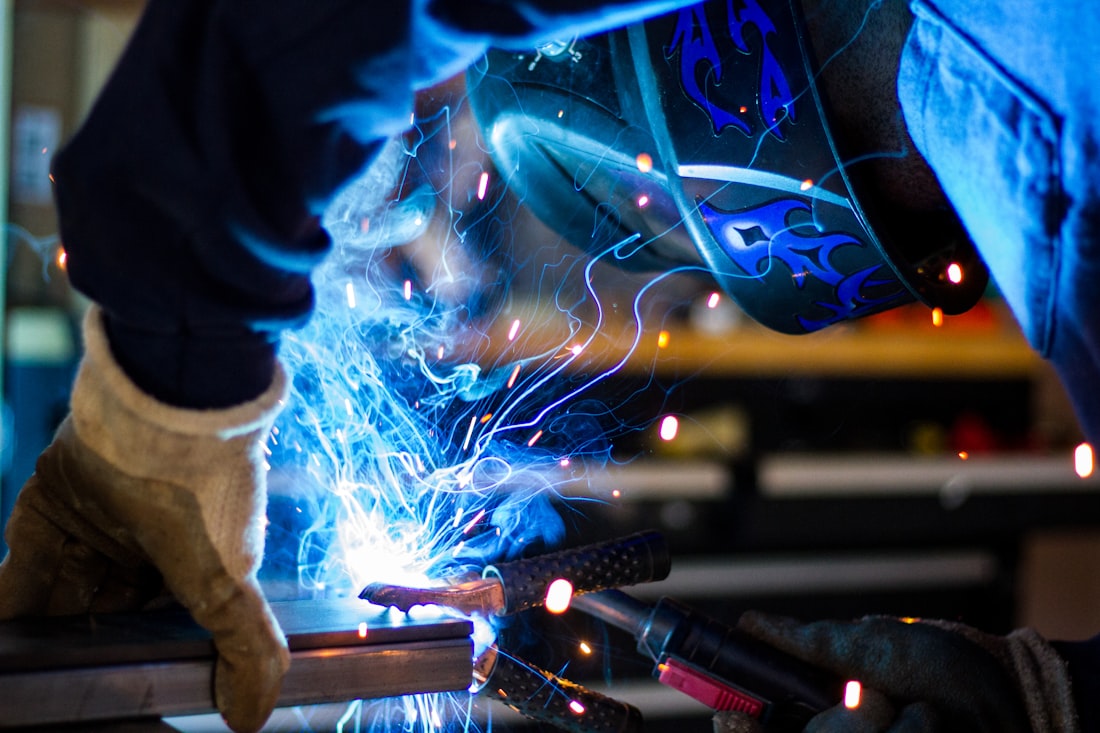
316 stainless steel costs more than 304 — typically 20-30% more on material — but it's the correct specification for anything exposed to salt air, which means most of Dubai Marina, JBR, Palm Jumeirah, and Jumeirah Beach Road. Workshops occasionally substitute 304 without telling the client because it's cheaper and looks identical when new. The tell is pitting and rust staining appearing within 12-18 months rather than the 8-10 years you'd expect from correctly specified 316. Ask for a mill certificate on the material if the job is coastal and the value justifies it — a legitimate fabricator will have one on file.
Fabrication and welding is a DED-licensed activity on the mainland, and most workshops trade as an LLC rather than as individual tradesmen — sole-trader arrangements barely exist in this sector because the DED structure doesn't really accommodate them for commercial work. For anything load-bearing — structural steel, mezzanine floors, external staircases forming part of a fire escape — the design needs sign-off from a structural consultant and, for buildings under Dubai Civil Defence's remit, DCD approval before installation. Skipping this isn't just a paperwork risk: if a mezzanine floor fails, liability traces back through whoever stamped the drawings, and an uncertified fabricator working without a consultant leaves the building owner exposed with no professional indemnity insurance standing behind the work. For anything fixed to the exterior of a building in a managed community — balcony grilles, security gates, external staircases — you'll also need a no-objection certificate from the building or community management before the fabricator starts, something easy to forget until the workshop turns up and the security desk turns them away.
A short conversation tells you most of what you need to know before signing anything.
Demand for fabrication work in Dubai isn't flat across the year. Villa renovations, new-build fit-outs and outdoor structural work cluster between October and April, when the weather makes site installation tolerable and most property transactions and handovers happen — lead times stretch and workshops get choosier about which jobs they take. Between mid-June and mid-September, the mandated midday break (12:30pm-3:00pm for outdoor labour) slows on-site installation and welding work specifically, even though workshop fabrication indoors continues normally, so anything requiring on-site welding or erection during peak summer should be quoted with a realistic timeline rather than the workshop's best-case one. Ramadan working hours, which shorten the working day across the whole sector, have a similar if smaller effect and are worth factoring into any deadline that falls during that period.
The most common failure isn't dishonesty, it's underestimating lead time on imported material — stainless steel sheet and specific profile sections aren't always held in local stock and can take three to six weeks to land from Europe or East Asia, which a workshop under pressure to win the job will not volunteer upfront. Ask directly whether the material is in stock in Dubai or needs ordering. The second common failure is a mismatch between the sample shown in the workshop and what turns up on site — thinner gauge, a rougher weld finish, cheaper hinges on a gate. A written specification with gauge and grade named protects you here far more than a verbal assurance. If a job goes wrong and the fabricator won't remedy it, a DED complaint is the first formal step for a licensed mainland company, and for anything over a modest value, Dubai's small claims tribunal (Centre for Amicable Settlement of Disputes, filed through the Dubai Courts portal) handles claims without needing a lawyer, provided you have the quote, payment records and photographs of the defect. Holding back a 5-10% retention until 30 days after installation, agreed in writing before work starts, remains the simplest protection against exactly this scenario.
Enjoy 5-star luxury at a most convenient hotel address. Facing Dubai Internatio...
Galeries Lafayette is a unique shopping destination with French heritage at the...



 Log in with Google