Article by:
DubaiDirectory

Overlooking the pristine waters of the Arabian Gulf and set in 19 acres of land...

Before you compare a single menu, check one thing: does the caterer hold a Dubai Municipality Food Safety Department approval for the kitchen they'll actually cook in? This is separate from their DED trade licence and it's the single biggest predictor of whether your event goes smoothly or ends with a food safety complaint. A huge amount of catering in this city, especially for smaller home gatherings and Instagram-driven orders, comes from operators cooking in domestic kitchens with no municipality inspection at all. That's illegal, uninsured, and the risk sits with you as the person who paid for it and served it to guests.
Legitimate catering companies operate from licensed commercial kitchens, usually clustered in Al Quoz, Ras Al Khor, and Dubai Investment Park, where industrial-grade rents and DED activity codes for food preparation are available. Ask for the trade licence number and the Food Safety Department permit number, then don't just take them at their word — the municipality's Food Watch portal lets you check registered establishments. Any caterer who hesitates or gives you a licence for a different activity (general trading, for example, rather than catering services) is a red flag.
Pricing in Dubai catering runs in fairly predictable bands once you know what drives it: cuisine complexity, service style, and whether staff and equipment are included.
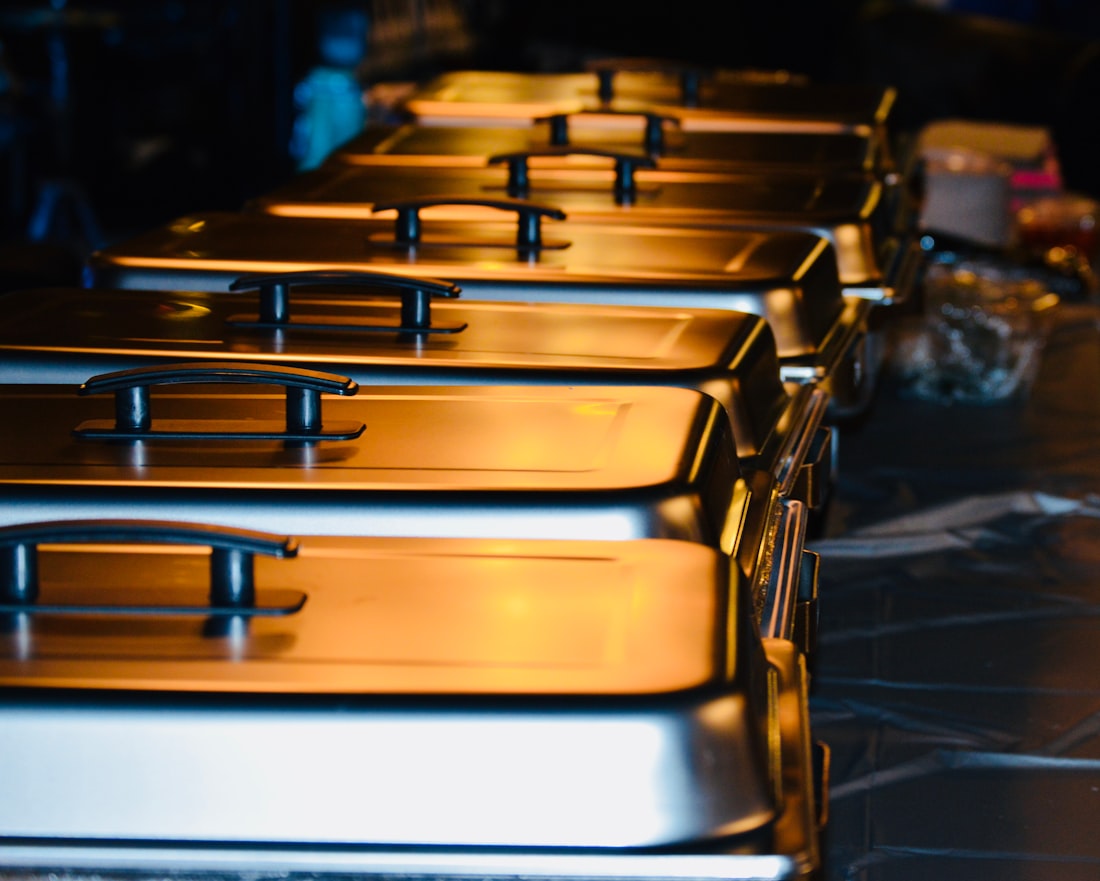
A standard corporate lunch buffet — rice, two mains, salad, dessert, delivered in chafing dishes with disposable service — sits around AED 45 to 90 per head, with a typical minimum order of 20 to 30 people. Push into a proper sit-down or live-station setup with chefs cooking to order (shawarma stations, pasta stations, teppanyaki) and you're looking at AED 120 to 250 per head, largely because you're now paying for chef labour, not just food cost. Wedding and gala catering, where menus stretch across multiple cuisines with waitstaff plating and clearing, typically runs AED 180 to 450 per head depending on whether it's a hotel-supplied menu or an external caterer brought into a licensed venue.
Daily office meal subscriptions are their own category and worth knowing about if you're managing a small team in Business Bay, JLT, or DIFC: expect AED 20 to 35 per meal on a weekly subscription, dropping further at volume. These are usually cold-boxed and delivered mid-morning, not hot-held, so factor that into expectations if your team wants a hot lunch.
Two costs catch first-time bookers out. First, 5% VAT is added on top of every quote — confirm whether the number you've been given is inclusive or exclusive before you compare two proposals. Second, waitstaff and equipment are frequently priced separately from the food. A single waiter runs roughly AED 150 to 250 per shift, and chafing dish, crockery, and cutlery rental (if you don't already have access through a venue) can add AED 15 to 40 per head on its own.
Catering companies in Dubai cannot supply or serve alcohol under their own licence. If your event includes drinks, the alcohol has to be sourced and served through a licensed venue — a hotel ballroom, a licensed club, or a private villa with the correct event permit arranged through the relevant authority. A caterer operating independently at, say, a warehouse space in Al Quoz or a private beach setup cannot simply bring in wine. If alcohol matters to your event, book the venue's licence status before you book the caterer, not after.
Demand for catering in Dubai isn't flat across the year, and pricing moves with it. Ramadan is the single busiest stretch for caterers: iftar and suhoor bookings for offices, mosques, and private homes spike hard, and popular kitchens get booked out three to four weeks in advance. Expect prices to rise 15 to 20% during this period simply because kitchens are running at capacity and turning away last-minute enquiries.
Winter, from roughly November through March, is wedding and gala season, coinciding with cooler evenings that make outdoor and garden events viable. Book six to eight weeks ahead for anything over 100 guests during this window, because the good venues and the caterers who work well with them fill up together. Summer, by contrast, is quiet for large events — outdoor catering drops off almost entirely between May and September — but corporate lunch catering stays steady since offices don't stop needing to eat. This is actually the best time to negotiate on corporate contracts, since caterers have spare kitchen capacity and are more willing to discount for a signed monthly agreement.
A quote that's just a per-head figure and a menu name tells you almost nothing. A quote worth signing off breaks down the food cost per head, staffing (numbers and hours, since staff on a four-hour event cost differently to an eight-hour wedding), equipment rental if applicable, delivery and setup fees (which matter more than people expect if your venue is a villa in Jumeirah or Al Barsha without loading access), and the cancellation and minimum-guarantee terms. Most reputable caterers require final numbers 48 to 72 hours before the event and will hold you to a minimum guaranteed headcount even if fewer people show up — that's standard practice, not a red flag, but it should be written down, not mentioned verbally.
Three questions do most of the vetting work. Ask where the food is physically prepared — a vague answer or an address that turns out to be a residential building is disqualifying. Ask whether they can provide a HACCP certificate or evidence of a recent municipality food safety inspection; a legitimate operator produces this without hesitation because they're inspected regularly anyway. And for anything over 50 guests, ask for a tasting session before you commit — any caterer confident in their food will offer this, usually for a small deposit that's credited against the final invoice, while operators reluctant to do a tasting are often reluctant because their scaled-up cooking doesn't match their sample photos.
One more practical point worth flagging: free zone-licensed catering companies (registered in a free zone such as DMCC) sometimes face restrictions delivering commercially outside that zone without a mainland trade licence or distributor arrangement. If you're booking a caterer for a mainland venue and their paperwork shows a free zone address, ask directly how they're licensed to deliver there. It's a niche issue but one that occasionally derails bookings at the last minute when nobody checked.
Overlooking the pristine waters of the Arabian Gulf and set in 19 acres of land...
Tribes is the realizationof one man's passion for all things African! From the ...



 Log in with Google